Flight attendants may pour drinks, serve meals and help you find space for your carry-on — and they’re coached on all of it — but those aren’t among their top priorities. Customer service is an important part of the job, but safety remains the primary focus.
Before new hires work a passenger flight, airlines drill them on emergency evacuations, fires, medical crises, decompression, security threats, aircraft systems and dozens of procedures they hope never to use. The training can last around two months, and beginning doesn’t guarantee graduation.
Among major U.S. carriers, Delta Air Lines currently runs one of the longest programs. New flight attendants complete seven weeks of on-site training in Atlanta, and Delta assigns their bases before training begins. United Airlines conducts 6.5 weeks of initial training at its Houston facility, and American Airlines also runs a 6.5-week course. Beyond the Big 3 carriers, U.S. programs range from Southwest Airlines’ consolidated four-week program to a chart-topping eight weeks with Hawaiian Airlines.
While the programs may differ considerably in length and include airline-specific procedures, federal regulations establish the safety competencies all U.S. carriers must address.
© Hulko Svitlana | Dreamstime
Airlines build their own FAA-approved programs around federal requirements and their particular fleets, equipment, policies and operating procedures, and flight attendants don’t earn a universal qualification that transfers from one airline to another. The FAA requires airlines to train crewmembers for the specific aircraft types, models, configurations and operations relevant to their jobs, so changing airlines means heading back to training. Move onto aircraft that require different procedures or equipment, and additional qualification may be required even at the same airline.
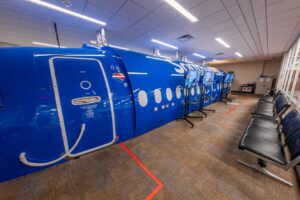
Plenty of flight attendant training takes place inside pieces of actual airplanes, full-sized cabin replicas, swimming pools and purpose-built rooms where instructors can fill the air with smoke and start fires. Inside Delta’s Atlanta facility, 30- to 40-foot aircraft sections drop oxygen masks, reproduce familiar onboard sounds, shake, and move up and down to simulate turbulence.
Trainees buckle into jump seats, hear the trouble begin and have to respond. Doors require a potentially surprising amount of hands-on practice. Trainees operate normal and emergency exits repeatedly until they can execute the procedures effectively, including deploying evacuation slides. FAA rules require airlines to train crews on the exits and emergency equipment installed on the type of aircraft where they’ll actually work, and federal evacuation demonstrations can require selected flight attendants to open designated exits and get slides ready for use within 15 seconds.
Instructors complicate standard door drills by introducing fire or debris outside an exit or declaring a door inoperable, forcing trainees to abandon the original evacuation plan, regroup and redirect passengers immediately.
Fire training sends trainees after burning lavatory waste bins, electronic devices and other simulated onboard fires with the same type of equipment they’ll have in the air. They have to locate the problem, select the correct extinguisher, communicate with the crew and fight the fire, all while contending with simulated smoke.
© Southwest Airlines
Federal rules require flight attendants to perform both firefighting and protective breathing equipment drills, and training scenarios can be intentionally over-the-top, with emergency after emergency piling up to test the endurance and level-headed decision making of future flight attendants.
Emergency commands intentionally bear little resemblance to the conversational tone flight attendants use during routine service; crews need brief, unmistakable instructions that cut through noise and panic, and trainees practice them relentlessly until the wording and actions become automatic. This is no pass/fail scenario, either. At Delta, for example, successful trainees need a 90 percent average on knowledge assessments and must successfully complete every hands-on evaluation, with up to three attempts for practical evaluations.
Getting people outside of the aircraft also means preparing for people to behave badly. During real evacuations, passengers have stopped to retrieve luggage, filmed emergencies instead of moving swiftly, and headed toward exits crews couldn’t safely use.
Though FAA warnings directly instruct passengers not to do many of these things, flight attendants still train extensively to take control of the cabin, redirect passengers, assist people who need help reaching an exit, and keep everyone moving safely when passengers are most likely to disregard or forget guidelines.
For ditching practice (abandoning the aircraft), trainees learn to prepare the cabin for a water landing. Federal requirements call for ditching drills to include the equipment actually installed aboard the aircraft, so programs involve training cabins that lead directly to swimming pools where trainees need to be able to operate equipment properly, tread water in clothing and help others out of water onto flotation devices.
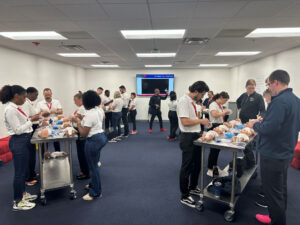
Infant CPR training © Delta Air Lines
United’s 125,000-gallon aquatic training center positions a mock aircraft beside a 7-foot-deep pool so trainees can jump directly into the water before pulling themselves into life rafts. Alaska Airlines takes water survival into colder territory, with fully clothed trainees working together in an Arctic survival drill to board rafts and preserve body heat.
Medical training for flight attendants includes first aid and the equipment they may need before a doctor or nurse ever responds to a request for help on board. The scenarios can range from cardiac emergencies to childbirth, which some airlines specifically teach crews to handle. Instructors push trainees through the practical response demonstrations, not just written exams; and federal training requirements encompass illness, injury and other abnormal situations involving passengers or crewmembers.
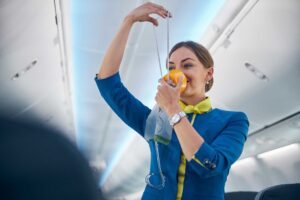
Decompression training goes well past instructing passengers to secure their own oxygen masks first. Flight attendants study hypoxia, how long a person may remain conscious without supplemental oxygen at altitude, gas expansion and the physical effects of decompression.
Then they learn the location and operation of oxygen equipment for both passengers and crew. Training devices can suddenly drop oxygen masks from overhead just as they would during a real event, and crews have to know what happens to the human body as well as what to do inside the cabin when the pressure drops.
Not every threat comes from the aircraft itself, though. Initial training also addresses hijacking, disruptive passengers, security problems, and the communication required between cabin crewmembers and the cockpit. Flight attendants may need to de-escalate an aggressive passenger, protect themselves physically or coordinate a response without alarming the rest of the cabin.
© Southwest Airlines
Of course, service training is also part of the curriculum, and some airlines take these details seriously. Singapore Airlines trainees learn everything from the proper way to crouch when retrieving something from the cabin floor to navigating the stairs aboard an Airbus A380.
Emirates has trained crews on precise tray presentation, wine pairings and how to assess intoxication before deciding whether to serve another drink.
Becoming a flight attendant requires an enormous amount of memorization. Southwest encourages trainees to know all public announcements by heart and memorize airport city codes before training even begins; they’re tested on them in the first week. Trainees across airlines learn emergency commands, equipment locations, aircraft systems, exits, communication procedures, safety regulations, passenger handling and the precise sequence of actions required when something goes wrong. Instructors then test whether they can retrieve the information under pressure and perform the procedures correctly.
Many airlines impose considerably higher internal standards than government agencies require. Despite weeks of training for little to no pay, failure remains a real possibility for many, making flight attendant school fundamentally different from most other employee orientations.
For those who do pass, graduation does not mean the end of training. Federal requirements send crews back for recurrent instruction and emergency drills throughout their careers, including specified hands-on drills at least once every 24 calendar months. They may practice catastrophes for decades without ever encountering most of them at work, but every routine flight still carries the possibility that one of those drills will suddenly matter.
Read This Next
All Reads on This Topic
Read Them All

Introducing
FX Excursions
FX Excursions offers the chance for once-in-a-lifetime experiences in destinations around the world.
#globility
Insta FeedDaily
Oct 9, 2026Andermatt, Switzerland, is This Year’s “It” Ski Destination
There’s no time like snow time — and if your idea of a grand winter escape means swooshing, shredding or schussing down a faraway slope and then relaxing in luxury, Andermatt, Switzerland, is the ideal destination. Located in the Urseren Valley and offering luxury lodging, Michelin-starred dining experiences and plenty of ski options, this corner of the central Andermatt Swiss Alps may just be the perfect winter season address.
Sponsored Content
Global Traveler Hosted Trip on the Transcend Connect
JOIN GLOBAL TRAVELER ON ITS NEXT TRIP!
Airlines
Oct 9, 2026Contour Airlines Adds Non-Stop Flights Between Alabama, Dallas
Travelers flying in and out of Northwest Alabama Regional Airport in Muscle Shoals, Alabama, can now utilize Contour Airlines' new non-stop services to Dallas Fort Worth International Airport, beginning Nov. 12. As part of this addition, five weekly flights from its existing Muscle Shoals to Charlotte (CLT) schedule will relocate to Dallas, allowing for convenient connection opportunities at one of the nation's major aviation hubs.
Daily
Oct 9, 2026Cruise the Nile with an Egyptologist on This New River Boat
Learn about ancient Egypt like never before (or perhaps experience your own real-life version of The Mummy) with Travelmarvel. The river cruise line returns to Egypt with the debut of its newest river ship, Travelmarvel Sirius, now sailing the Nile.
Sponsored Content
Elevate Your Journey with TAP Air Portugal’s New Economy Prime
Exciting news ahead for TAP Air Portugal, as Portugal’s flag carrier prepares for the launch of its brand-new Economy Prime cabin, offering customers more space, additional privacy and a superior travel experience. Flights boasting the new cabin take off June 1; booking for Economy Prime is now available across all TAP channels and travel agents.
Daily
Oct 8, 2026Four Seasons Resort Bali at Sayan Unveils Reimagined Suites
Designed in harmony with the Ayung River valley, Four Seasons Resort Bali at Sayan recently unveiled seven newly reimagined suites, with floor-to-ceiling windows framing the Ayung River valley and handcrafted Balinese details bringing a sense of place. The five Premier Duplex Suites and two Premier Family Suites were created with Hirsch Bedner Associates.

Review: Prestige Oceanfront Resort
eFlyer Reviews
Oct 7, 2026Why Morocco Should Be Your Next Golf Getaway
Daily
Oct 7, 2026Airlines
Oct 7, 2026Avelo Airlines Adds 4 New Non-Stop Destinations from Dallas’ DTX Airport
Avelo Airlines announced four new non-stop routes and a third based aircraft at Dallas’ McKinney National Airport, increasing the airline’s Collin County network to nine destinations.
Sponsored Content
What Actually Happens If You Get Sick or Hurt on a Cruise?
You’ve booked your cabin, mapped the ports and packed the sunscreen. Hopefully, you also bought some insurance. But have you ever thought about what actually happens if a medical emergency strikes mid-voyage?
Hotels
Oct 7, 2026Kimpton’s First All-Inclusive Resort Opens in Mexico’s Riviera Maya
Kimpton’s first all-inclusive resort officially opens within a 340-acre nature preserve in Mexico’s Riviera Maya. Kimpton Tres Rios – All Inclusive is the destination’s latest luxury property, spanning 335 accommodations.
ShareThis