Diploma in hand, Brian Foley left Syracuse University in 1980 and headed west to Renton, Washington, for his dream job as a flight test engineer for the first Boeing 757 commercial airliner.
We’d have to simulate failures,” recalled Foley, who earned his pilot’s license at 17. “We’d skid the tail along the ground during takeoff. Basically, you got to do everything you shouldn’t do. There were some white-knuckle moments for sure. I mean, wow!”
Foley, who spent a quarter-century at Boeing and Dassault Falcon Jet before becoming a New York-based aviation analyst, may have held one of the industry’s more glamorous posts, but flight tests are just one phase of the multibillion-dollar, decade-long process of taking an aircraft from concept to commercial flight.
“Going from sketchpad to commercial launch is a very expensive proposition, and it takes a whole lot of time,” Foley said. It also requires millions of components joined with sub-millimeter precision and Federal Aviation Administration oversight that could last years.
Certainly, the manufacturing, design, construction and certification of aircraft have matured since the Wright brothers attached a 12-horsepower engine to a frame made of wood, wire and muslin in 1903. The historic 12-second flight covered 120 feet — less than the wingspan of the aircraft destined to revolutionize global travel nearly 70 years later: the Boeing 747.
In 1966 Pan Am placed a historic $525 million order for 25 Boeing jumbo jets that would make air travel accessible to the masses. Joe Sutter, Boeing’s legendary chief engineer, known as the “Father of the 747,” presided over a team of 4,500 engineers, mechanics and administrators to deliver the world’s first widebody jumbo jet in record time. Collectively known as “The Incredibles,” the team took the 747 from concept to launch in less than five years — “and in a day of slide rules, no less,” Foley said.
Pan Am’s first Boeing 747 commercial flight took off on Jan. 22, 1970, traveling from New York’s John F. Kennedy International Airport to London Heathrow Airport. It sported a distinctive hump on the upper deck to house the cockpit and additional passenger space, remaining in operation for 54 years.
Dubbed the “Queen of the Skies,” Boeing’s ambitious jumbo jet democratized global long-haul travel, fundamentally changing aircraft cabin design and revolutionizing how people and goods moved about the world. Just two years later, Boeing’s archrival Airbus countered with the A300, the world’s first twin-engine widebody airliner. Together, the pair of dueling jumbo jets heralded the Golden Age of air travel.
Such truncated timelines would be unheard of today. Nowadays, developing new aircraft takes more time, money and resources than ever before due to stricter federal regulations, unwieldy global supply chains and layers of internal red tape, according to Foley. Technology expedites certain processes but prolongs others, entailing “millions of lines of software code to optimize aircraft design that then need to be integrated into modern aircraft systems.”
“Creating an entirely new jetliner involves a massive multiphase engineering and regulatory timeline,” Foley said. The first two years are spent in the conceptual and preliminary design phase, defining mission capability, size, aerodynamics and engine choices. The next two to three years are devoted to developing a detailed design using computer-aided design to test virtual simulations before building physical prototypes. The resulting blueprint serves as the foundation for the manufacturing process.
Manufacturers may create as many as half a dozen prototypes to undergo different tests over thousands of hours in conjunction with the FAA. “On the ground you bend the wings literally until they break, just to double-check that it can handle the maximum loads,” Foley said. “Then you might simulate pressurization and landings that the airplane would see over years of continuous use.”
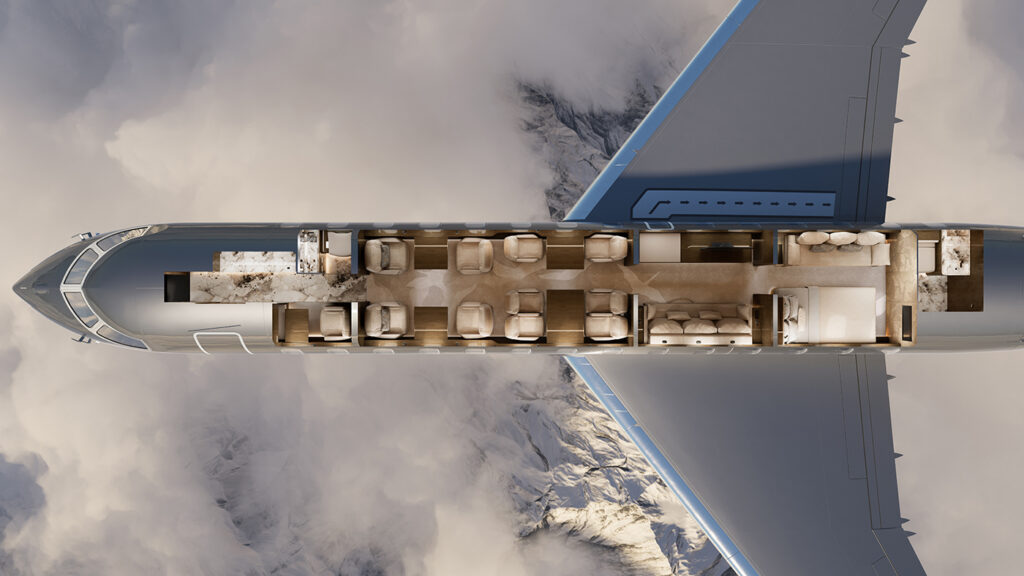
PHOTO: © BOMBARDIER
Commercial airliners carry hundreds of passengers, but even private jets that seat fewer than 20 require multidisciplinary design, supply chain coordination, certification and support, taking years to complete from concept to launch, said Scott Evans, director of flight operations, Gulfstream Aerospace.
“From beginning to end, we study human factors to figure out what the human–machine interface needs,” Evans said. “We have industrial designers who make our thoughts reality on screen down to the pixel. We have engineers designing for structural loads and increasing the differential pressure so that we can bring the cabin altitude down.”
The level of detail that goes into developing an ultra-long-range jet — such as Gulfstream’s recently launched flagship G700 and G800 or Bombardier’s Global 8000, for example — with an $80 million price tag is extreme. Engineers and designers must grapple with thousands of minute considerations, from making sure drawers close seamlessly to ensuring switches flip smoothly.
“It’s the smallest details that matter,” Evans said. “Each one plays into a collective experience, so it’ll be drawers. It’ll be lights. It’ll be shades. It’ll be seats, bulkheads, veneers, flooring. We’ll go fly 1,000-plus hours to test any aspect that you’re going to feel, touch or experience.”
In the world of private aviation, merely building and certifying a new model may seem like only half the battle. Gulfstream, Embraer and Bombardier have in-house design teams that can work with clients concurrent to their new build, but sometimes creating a bespoke cabin for a discerning client can extend the timeline by months or years.

PHOTO: © SAMI JO STUDIOS
“Planning, designing, ordering equipment — I try to be white-glove, advising the client in every aspect,” said Los Angeles-based private-jet designer Sarah Mespelt Larrañaga. She has delivered more than 100 aircraft from Gulfstream, Dassault, Bombardier, Boeing and Airbus to billionaire clients and corporate customers. “The whole process from A to Z could be around a year.”
One of Larrañaga’s highest-profile projects, Paris Hilton’s Gulfstream 450, entailed a full-scale interior refurbishment, from retrofitting its avionics equipment for a state-of-the-art entertainment system to incorporating sparkly pink carpeting, lighting and wallpaper throughout the cabin. For the exterior, Larrañaga worked with Pittsburgh-based paint manufacturer PPG to design a bespoke shade the company has since added to its catalogue as “Paris Pink.”
But one of the most vexing elements in any jet refurbishment hides beneath the cockpit floor, according to Larrañaga. Whether designing a Bombardier Challenger 300, Gulfstream G650 or, for her latest project, a Boeing 767, she finds more clients requesting Starlink for high-speed Internet and video meetings at 40,000 feet, a feat that may call for a new cabin management system, the centralized digital platform controlling the plane’s electronic functions.
Indeed, it’s a race to the top for private jet purveyors. Brazilian aerospace firm Embraer, which makes the world’s best-selling bizjet, the nine-passenger Phenom 300, launched its Praetor 600E earlier this year. The advanced, super- midsize business jet features a 42-inch 4K OLED “Smart Window” with a curved touchscreen display that controls video conferencing, entertainment streaming and real-time sky views.
Manufacturers also collaborate with fashion houses on one-off designs to stand out in a competitive luxury market. In June, Canadian business jet manufacturer Bombardier unveiled a collaboration with Elie Saab, a fashion designer best known for dressing Halle Berry, Céline Dion, Angelina Jolie and Beyoncé. The “haute couture” Global 8000 marked Saab’s first foray into aircraft design, complete with walk-in wardrobe, a five-seat divan sofa and an aviation-certified marble shower.
Read This Next

Introducing
FX Excursions
FX Excursions offers the chance for once-in-a-lifetime experiences in destinations around the world.
#globility
Insta FeedDaily
Nov 20, 2026Cunard’s “Queen Mary 2”’s New Interiors Inspired by Golden Age of Ocean Travel
Cunard recently unveiled the design vision for Queen Mary 2’s interiors; the luxury ocean liner will return to service in May 2027 following its significant refurbishment. The reveal was timed to the ship’s departure from Southampton on Nov. 10 for her 450th Transatlantic Crossing.
Sponsored Content
Elevate Your Journey with TAP Air Portugal’s New Economy Prime
Exciting news ahead for TAP Air Portugal, as Portugal’s flag carrier prepares for the launch of its brand-new Economy Prime cabin, offering customers more space, additional privacy and a superior travel experience. Flights boasting the new cabin take off June 1; booking for Economy Prime is now available across all TAP channels and travel agents.
Daily
Nov 20, 2026What’s New at Nayara Resorts?
Nayara Resorts unveils on-property updates, finding new ways for guests to interact with each destination. Keep reading to get an inside look on what’s new at Nayara Resorts across the world:
Daily
Nov 20, 2026Escape the Chill with Bespoke Adventure Tours in Costa Rica
Snow season is just around the corner, and savvy travelers are already making plans to take a winter break in a warm locale. Specialists in travel to Guanacaste, Costa Rica, Flamingo Expeditions has more than 20 years of experience planning custom tours that are sustainable, environmentally focused, and designed to support and strengthen local communities while offering great experiences to travelers.
Sponsored Content
Global Traveler Hosted Trip on the Transcend Connect
JOIN GLOBAL TRAVELER ON ITS NEXT TRIP!
Daily
Nov 19, 2026Wellness-Inspired Hotel Brand Makes Landmark Debut in Vietnam’s Capital
Opened this past September, LÈGACY Hanoi, a Fusion Original, is a stylish 218-room hotel and wellness sanctuary offering spectacular views of the city and West Lake in Vietnam’s capital city. The new hotel marks the latest chapter in Fusion Hotel Group’s expansion and reinforces its leadership role in Vietnam’s dynamic, wellness-inspired hospitality landscape.
Head to Croatia for a Wellness Reset
Daily
Nov 18, 2026Shows to See in NYC Now
Destinations
Nov 18, 2026Daily
Nov 18, 2026Why Three Waters Resort & Marina in Islamorada, Florida, is Worth a Visit
Home to 214 rooms, suites and cottages, Three Waters Resort and Marina is a tucked-away oasis on the coast where the Atlantic Ocean, Gulf of Mexico and Florida Bay blend seamlessly to create crystal-blue waters.
Sponsored Content
IHG Business Edge: A Smarter Way for Small- and Mid-Sized Businesses to Travel
IHG Business Edge is a complimentary travel program designed to help small- and mid-sized businesses manage travel more efficiently while saving on hotel stays. Members enjoy access to guaranteed discounts, loyalty benefits, and partner offers across IHG Hotels & Resorts’ global portfolio of 7,000-plus hotels in more than 100 countries.
eFlyer Reviews
Nov 18, 2026Review: Velas Vallarta
Savvy travelers demanding authenticity in all-inclusive Mexican luxury travel may be familiar with family-owned, 5-star Grand Velas collection and adults-only Grand Velas Boutique Hotel, Casa Velas and Mar del Cabo. With that, Puerto Vallarta visitors should consider revisiting the 4-star all-inclusive Velas Vallarta, which — even with new upgrades — retains the blueprint established by founder Eduardo Vela Ruiz, who recognized the importance of surrounding visitors with the cultural, architectural and botanical character of the region while making them feel settled and well-cared for.
ShareThis