The desire to fly is lodged deep in the human psyche. Aside from the common dream of being airborne, references abound in old tales and myths. In the epic poem Shahnameh by long-ago Persian poet Ferdowsi, the fabled King Kai-Káús possessed a flying throne that was drawn into the sky and held aloft by a team of colossal eagles. Built of gold and wood, this throne craft may not have been aerodynamic in design or particularly comfortable to travel in, but it managed to bear the daring king all the way to China.
That poem with the eagle-powered throne is only one of a host of similar tales. Norse mythology’s Völundr the Smith escaped the clutches of King Nidud by fashioning a pair of wings which allowed him to fly free from captivity; and most of us know of the less successful journeys of Icarus, Phaethon and Sumeria’s King Etana.
While you probably won’t find a flying throne or wax-and-feather wings in a museum exhibition, you can peruse a host of documents, flight artifacts and carefully preserved flying machines, many of them with storied pasts. Offering hours of plane-gazing, educational programs and opportunities for guided flights in vintage craft, these museums occupy grand edifices such as the Smithsonian National Air and Space Museum and Udvar-Hazy Center in Washington, D.C., and Chantilly, Virginia, respectively, as well as far more modest structures housing specialty compilations such as those found at Palm Springs Air Museum in Palm Springs, California, or Royal Flying Doctor Service Museum in Alice Springs, Australia. At the Alice Springs facility, displays chronicle the aeromedical emergency services that to this very day manage to reach Australia’s most remote locations.
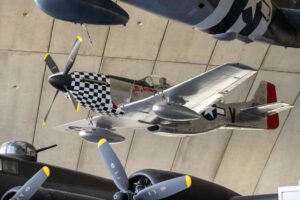
P-51 Mustang fighter at American Air Museum at IWM in Duxford, England © Joseph Creamer | Dreamstime
IWM Duxford museum in Cambridgeshire, England — one of five institutions comprising Britain’s Imperial War Museums — includes a preserved airfield and regularly hosts airshows with vintage aircraft, such as the Duxfor Battle of Britain Air Show. The museum also houses the only Lockheed SR-71 Blackbird outside of the United States. This two-seat, twin-engine supersonic reconnaissance aircraft can reach the incredible speed of Mach 3.2. Flight experiences in vintage airplanes range from a Spitfire, Hurricane, Mustang or Lysander to the only existing air-worthy Blenheim. Visitors can also book air tours over London or Cambridge in an open-cockpit De Havilland Tiger Moth.
Just outside Denver, Colorado, Wings Over the Rockies Air & Space Museum houses more than 60 aircraft and a selection of space artifacts. Planes include the Alexander Eaglerock, built by Alexander Film Studios in the 1920s as a way to facilitate film distribution in an efficient manner. Conceived by the company’s teenaged, newly named chief engineer, Al Mooney, and constructed at the studio’s own aircraft factory in Englewood, Colorado, the Alexander Eaglerock launched a spate of construction that saw Colorado briefly become the largest producer of airplanes in the United States. Since designing that first plane with its original 100 horsepower Curtiss OX-5 engine, Mooney went on to engineer the Culver Dart and Cadet, the Bellanca Airbus and a selection of Lockheed aircraft.
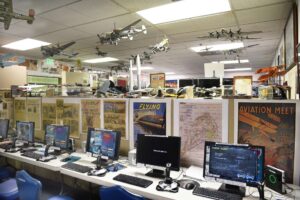
Palm Springs Air Museum © Steve Cukrov | Dreamstime
“Wings Over the Rockies has classics [such as] the B-52, B-1, F-4 Phantom and Harrier, but some of my favorite surprises are the oddballs,” said Rachel Herman, chief experience officer, Wings Over the Rockies. “The RF-84K Thunderflash was one of only a small number of aircraft modified as a ‘parasite’ plane, designed to be carried beneath a massive B-36 bomber and released closer to its reconnaissance target. A specialized hook allowed it to connect to a trapeze beneath the bomber, detach for its mission and then reconnect in flight.
As you might imagine, rendezvous wasn’t easy, and rapid advances in jet technology made the concept obsolete after just two years. The wildest part, at least to me, was what was asked of the pilots. Missions could keep RF-84K pilots in that tiny cockpit for hours on end. Get me a good book and a few snacks!”
Among the vast collections housed within the Smithsonian National Air and Space Museum in Washington, D.C., is the original 1903 Wright Flyer. This canard biplane — a four-cylinder, wood-and-muslin craft — is the very one that lifted Orville Wright above the sandy earth of Kill Devil Hills near Kitty Hawk, North Carolina, in December 1903. Other famous planes on view include the De Havilland Comet, the world’s first jet engine-powered transportation; and Lindbergh’s Spirit of St. Louis, which accomplished the first non-stop, solo trans-Atlantic flight in 1927 when it left the runway in New York and landed in Paris, France.
Exhibitions at the Smithsonian air museum don’t stop at aircraft. Aviation’s history is spelled out in flight objects; artifacts; and works of art and photography related to aviation, including a stunning array of photos of World War II women pilots by Anne Noggle. A former pilot herself, Noggle became obsessed with the idea of flying as a young girl after seeing an aerial performance at a nearby airfield given by Amelia Earhart. Noggle’s moving portraits of women pilots stand out as an exhibition highlight.
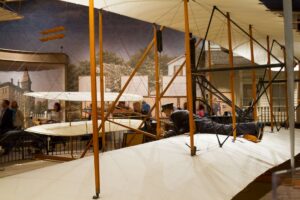
Wright Brothers’ 1903 Flyer at Smithsonian National Air and Space Museum © Arak7 | Dreamstime
Standing near the famous Spruce Goose at Evergreen Aviation & Space Museum in McMinnville, Oregon, visitors may be initially fooled into thinking the mammoth plane’s shiny exterior is made of metal, but it’s all show. Beneath the paint of this Hughes H-4 Hercules (the largest seaplane ever built) sits an enormous wooden frame mostly composed of birch. Restrictions regarding the use of aluminum during war years forced the plane’s designers, Henry J. Kaiser and Howard Hughes, to get creative. And they did: To bend the thin wood veneer into shape, it was ironed into compliance by women working at Roddis Manufacturing before being finished with rice paper and shiny silver aluminum paint.
Within the United States, visit-worthy aviation museums include Pima Air & Space Museum in Tucson, Arizona; National Museum of the U.S. Air Force in Dayton, Ohio; Delta Flight Museum in Atlanta, Georgia; and EAA Museum in Oshkosh, Wisconsin. The Sullenberger Aviation Museum, a Smithsonian Affiliate located at Charlotte Douglas International Airport in North Carolina (previously the Carolinas Aviation Museum, renamed in honor of Capt. C.B. “Sully” Sullenberger of the Miracle on the Hudson fame), focuses on artifacts directly related to the aviation history of North and South Carolina.
Exhibitions include textiles, memorabilia, clothing, gear, photos and oral histories, along with 40 aircraft. Some, housed in the historic WPA/Douglas hangar area, include an F-84 Thunderjet, a Stearman biplane and a Lockheed T-33.

The “parasite” plane, RF-84F Thunderflash, being released from beneath a Convair GRB-36F Peacemaker bomber © U.S. Air Force
There are other impressive collections spread across the globe, from Red Bull Hangar-7 in Salzburg, Austria, to the Polish Aviation Museum in Krakow, Poland. Others include Museo de Aeronáutica y Astronáutica in Madrid, Spain; Museum of Air and Space in Le Bourget, France; and Aerospace Bristol in Bristol, United Kingdom. The China Aviation Museum in Beijing displays more than 200 aircraft, punctuated with exhibits of weapons and radar systems.
Within the Canada Aviation and Space Museum in Ottawa, Canada, find the last known surviving piece of the CF-105 Avro Arrow. Within aviation history this plane’s significance is well-recognized and would have likely been far greater had the plane ever made it into service. With a sleek, advanced design enabling a speed of Mach 2 at 50,000 feet, it was destined to intercept Soviet bombers in extreme northern regions, flying above the Arctic. In 1959 the program behind its development was suddenly scrapped by then-Prime Minister John Diefenbaker when military intelligence sources and political decision-makers recalculated the threat of bombers from the Soviet Union, citing the launch of missiles with nuclear payloads as a far greater and more imminent hazard.
Flying thrones and eagles notwithstanding, forays into an even older story of flight are possible at several museum libraries in Europe that serve as repositories for the drawings and notes composed by artist and inventor Leonardo da Vinci. Among these sketches and musings, created during the 1500s, many speculate on possible ways and means humans might depart terra firma in favor of the skies. Da Vinci’s intense studies regarding the aerial movements of birds, bats and flying insects resulted in his Codex on the Flight of Birds (housed in the Royal Library of Turin/Biblioteca Reale) and sketches for an “ornithopter” that shares design elements with both birds and modern helicopters. Visitors to Florence, Italy, can view models up close at Leonardo Interactive Museum.

Oikush Museum of Aviation in Krakow, Poland © Maryna Kordiumova | Dreamstime
And although Da Vinci never actually constructed his own models, modern reproductions based on his drawings and theories, including the “aerial screw,” have been created and are currently being studied by experts. These include a research team based at Johns Hopkins University and led by Rajat Mittal, a professor of mechanical engineering working toward applications in the area of quiet drone flights.
All told, the sheer number — and very existence — of these museums illuminates mankind’s courage and innovation, illustrating how aviation has more closely linked the greater world, reducing even vast distances to navigable lengths. So venture forth and map out your own route of discovery. Chances are better than good there’s a flight to take you there.
Read This Next

Introducing
FX Excursions
FX Excursions offers the chance for once-in-a-lifetime experiences in destinations around the world.
#globility
Insta FeedDaily
Oct 14, 2026Corinthia Announces New Hotel, Residences in Turks and Caicos
Corinthia Group recently announced the development of a landmark ultra-luxury hotel and branded residential project on Grace Bay in Turks and Caicos, set on the last remaining undeveloped beachfront parcel on a prime stretch of Grace Bay. The development will include an ultra-luxury, 50-suite, Corinthia-branded hotel and an exclusive collection of fully serviced branded residences, including beachfront villas, casitas and condominiums. The project is in partnership with Carolina Partners Ltd.
Sponsored Content
Extraordinary Moments, Made to Keep
The Excellence Collection offers a curated collection of luxurious resorts across Mexico and the Caribbean, promising exceptional experiences for every guest and taste. From upscale suite concepts to a plethora of gourmet dining options, from wellness experiences to curated activities, The Excellence Collection guarantees all this and more.
Daily
Oct 14, 2026Four Seasons Resort Tamarindo Debuts Cultural Programming
Four Seasons Resort Tamarindo, in the Costalegre region of Mexico, invites travelers to explore a different Día de Muertos, one of Mexico’s most meaningful holidays. To celebrate, the property introduces its first-ever month-long celebration with a calendar of on-property cultural events.
Destinations / North America
Oct 14, 2026Review: Villatel Resort Orlando
Opened March 2025, Villatel Resort Orlando is one of Orlando’s newest elevated resorts, but far more unique and private than you’ll find at many other resorts and hotels in the area. The name alone points to an experience beyond your typical hotel room or suite; here, you have the flexibility to select from a wide range of modern villas, ranging from four to nine bedrooms, as well as a series of Apartments by Marriott Bonvoy units.
Sponsored Content
GET TO KNOW TAP FORBIZ
Unlock flexible, refined business travel with TAP Air Portugal’s program, TAP FORBIZ. Developed for small, medium and large Companies, with options for corporate events, TAP FORBIZ offers exclusive advantages adapted to each type of business.
eFlyer News
Oct 14, 2026Amex Announces Largest Centurion Lounge Network Expansion to Date
American Express undergoes its largest Centurion Lounge Network expansion to date across four locations. The network expansion includes a brand-new Centurion Lounge at Newark Liberty International Airport, a second lounge at London Heathrow Airport, and significant expansions of existing lounges at both Philadelphia International Airport and George Bush Intercontinental Airport.

eFlyer Lead
Oct 14, 2026Bed Bugs on Planes? Rare, But It Just Happened …
It’s a traveler’s worst nightmare: bed bugs. The insect’s name suggests they are limited to beds, meaning the worry is restricted solely to homes, hotels, vacation rentals and any other place we could possibly rest our heads. But, on planes? Well, bed bugs have and do indeed infiltrate the fabrics of even these seats, despite many of us not actually getting any rest on a plane.
Sponsored Content
Get to Know TAP FORBIZ
Unlock flexible, refined business travel with TAP Air Portugal's program, TAP FORBIZ. Developed for small, medium and large Companies, with options for corporate events, TAP FORBIZ offers exclusive advantages adapted to each type of business. TAP FORBIZ offers solutions suited to each business: travel cost reduction, more flexibility, more benefits and more value. With TAP FORBIZ, businesses can centralize purchases, control the company budget and ensure greater cost predictability with exclusive discounts and benefits tailored to each company's profile. Each trip becomes a strategic decision to travel more and spend less.
Daily
Oct 14, 20263 Movie Theaters in Northern California Get a Grand Redesign
CAW Architects, a firm recognized for its sensitive stewardship of Northern California’s architectural heritage, announced the completion of three performance venues, bridging the gap between historic preservation and modern technical innovation. From the $41 million restoration of San Francisco’s legendary Castro Theatre to the topography-driven "resculpting" of UC Berkeley’s Hearst Greek Theatre to the ground-up industrial craftsmanship of Sacramento’s Channel 24, CAW’s latest work ensures the region’s most beloved gathering places remain vibrant, inclusive and future-ready.
ShareThis