Flight attendants may pour drinks, serve meals and help you find space for your carry-on — and they’re coached on all of it — but those aren’t among their top priorities. Customer service is an important part of the job, but safety remains the primary focus.
Before new hires work a passenger flight, airlines drill them on emergency evacuations, fires, medical crises, decompression, security threats, aircraft systems and dozens of procedures they hope never to use. The training can last around two months, and beginning doesn’t guarantee graduation.
Among major U.S. carriers, Delta Air Lines currently runs one of the longest programs. New flight attendants complete seven weeks of on-site training in Atlanta, and Delta assigns their bases before training begins. United Airlines conducts 6.5 weeks of initial training at its Houston facility, and American Airlines also runs a 6.5-week course. Beyond the Big 3 carriers, U.S. programs range from Southwest Airlines’ consolidated four-week program to a chart-topping eight weeks with Hawaiian Airlines.
While the programs may differ considerably in length and include airline-specific procedures, federal regulations establish the safety competencies all U.S. carriers must address.

© Hulko Svitlana | Dreamstime
Airlines build their own FAA-approved programs around federal requirements and their particular fleets, equipment, policies and operating procedures, and flight attendants don’t earn a universal qualification that transfers from one airline to another. The FAA requires airlines to train crewmembers for the specific aircraft types, models, configurations and operations relevant to their jobs, so changing airlines means heading back to training. Move onto aircraft that require different procedures or equipment, and additional qualification may be required even at the same airline.
Plenty of flight attendant training takes place inside pieces of actual airplanes, full-sized cabin replicas, swimming pools and purpose-built rooms where instructors can fill the air with smoke and start fires. Inside Delta’s Atlanta facility, 30- to 40-foot aircraft sections drop oxygen masks, reproduce familiar onboard sounds, shake, and move up and down to simulate turbulence.
Trainees buckle into jump seats, hear the trouble begin and have to respond. Doors require a potentially surprising amount of hands-on practice. Trainees operate normal and emergency exits repeatedly until they can execute the procedures effectively, including deploying evacuation slides. FAA rules require airlines to train crews on the exits and emergency equipment installed on the type of aircraft where they’ll actually work, and federal evacuation demonstrations can require selected flight attendants to open designated exits and get slides ready for use within 15 seconds.
Instructors complicate standard door drills by introducing fire or debris outside an exit or declaring a door inoperable, forcing trainees to abandon the original evacuation plan, regroup and redirect passengers immediately.
Fire training sends trainees after burning lavatory waste bins, electronic devices and other simulated onboard fires with the same type of equipment they’ll have in the air. They have to locate the problem, select the correct extinguisher, communicate with the crew and fight the fire, all while contending with simulated smoke.
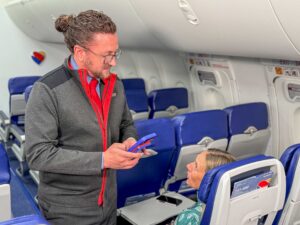
© Southwest Airlines
Federal rules require flight attendants to perform both firefighting and protective breathing equipment drills, and training scenarios can be intentionally over-the-top, with emergency after emergency piling up to test the endurance and level-headed decision making of future flight attendants.
Emergency commands intentionally bear little resemblance to the conversational tone flight attendants use during routine service; crews need brief, unmistakable instructions that cut through noise and panic, and trainees practice them relentlessly until the wording and actions become automatic. This is no pass/fail scenario, either. At Delta, for example, successful trainees need a 90 percent average on knowledge assessments and must successfully complete every hands-on evaluation, with up to three attempts for practical evaluations.
Getting people outside of the aircraft also means preparing for people to behave badly. During real evacuations, passengers have stopped to retrieve luggage, filmed emergencies instead of moving swiftly, and headed toward exits crews couldn’t safely use.
Though FAA warnings directly instruct passengers not to do many of these things, flight attendants still train extensively to take control of the cabin, redirect passengers, assist people who need help reaching an exit, and keep everyone moving safely when passengers are most likely to disregard or forget guidelines.
For ditching practice (abandoning the aircraft), trainees learn to prepare the cabin for a water landing. Federal requirements call for ditching drills to include the equipment actually installed aboard the aircraft, so programs involve training cabins that lead directly to swimming pools where trainees need to be able to operate equipment properly, tread water in clothing and help others out of water onto flotation devices.
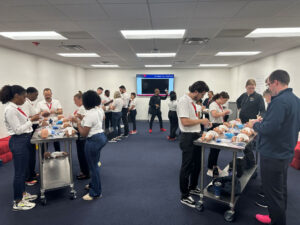
Infant CPR training © Delta Air Lines
United’s 125,000-gallon aquatic training center positions a mock aircraft beside a 7-foot-deep pool so trainees can jump directly into the water before pulling themselves into life rafts. Alaska Airlines takes water survival into colder territory, with fully clothed trainees working together in an Arctic survival drill to board rafts and preserve body heat.
Medical training for flight attendants includes first aid and the equipment they may need before a doctor or nurse ever responds to a request for help on board. The scenarios can range from cardiac emergencies to childbirth, which some airlines specifically teach crews to handle. Instructors push trainees through the practical response demonstrations, not just written exams; and federal training requirements encompass illness, injury and other abnormal situations involving passengers or crewmembers.
Decompression training goes well past instructing passengers to secure their own oxygen masks first. Flight attendants study hypoxia, how long a person may remain conscious without supplemental oxygen at altitude, gas expansion and the physical effects of decompression.
Then they learn the location and operation of oxygen equipment for both passengers and crew. Training devices can suddenly drop oxygen masks from overhead just as they would during a real event, and crews have to know what happens to the human body as well as what to do inside the cabin when the pressure drops.
Not every threat comes from the aircraft itself, though. Initial training also addresses hijacking, disruptive passengers, security problems, and the communication required between cabin crewmembers and the cockpit. Flight attendants may need to de-escalate an aggressive passenger, protect themselves physically or coordinate a response without alarming the rest of the cabin.
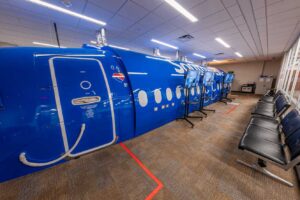
© Southwest Airlines
Of course, service training is also part of the curriculum, and some airlines take these details seriously. Singapore Airlines trainees learn everything from the proper way to crouch when retrieving something from the cabin floor to navigating the stairs aboard an Airbus A380.
Emirates has trained crews on precise tray presentation, wine pairings and how to assess intoxication before deciding whether to serve another drink.
Becoming a flight attendant requires an enormous amount of memorization. Southwest encourages trainees to know all public announcements by heart and memorize airport city codes before training even begins; they’re tested on them in the first week. Trainees across airlines learn emergency commands, equipment locations, aircraft systems, exits, communication procedures, safety regulations, passenger handling and the precise sequence of actions required when something goes wrong. Instructors then test whether they can retrieve the information under pressure and perform the procedures correctly.
Many airlines impose considerably higher internal standards than government agencies require. Despite weeks of training for little to no pay, failure remains a real possibility for many, making flight attendant school fundamentally different from most other employee orientations.
For those who do pass, graduation does not mean the end of training. Federal requirements send crews back for recurrent instruction and emergency drills throughout their careers, including specified hands-on drills at least once every 24 calendar months. They may practice catastrophes for decades without ever encountering most of them at work, but every routine flight still carries the possibility that one of those drills will suddenly matter.
Read This Next

Introducing
FX Excursions
FX Excursions offers the chance for once-in-a-lifetime experiences in destinations around the world.
#globility
Insta FeedDaily
Nov 25, 2026Shanghai Opera House Opens
New Shanghai Grand Opera House officially opened Oct. 17, marking the culmination of a decade‑long project and the launch of its inaugural performance season through Feb. 20, 2027.
Sponsored Content
The World Awaits with Turkish Airlines’ Global Access
Turkish Airlines enjoys the unique position as the airline flying to more countries than any other airline. Its unrivaled global reach is only the beginning of the experience that awaits passengers with Turkish Airlines.
eFlyer Reviews
Nov 25, 2026Review: Kindler Wood-Fired Fare
Three Waters Resort and Marina is home to many memorable dining experiences, such as Tiki Bar, Little Limon and Islamorada Pizza Co. However, Kindler Wood-Fired Fare takes the trophy as my favorite eatery at the resort.
eFlyer News
Nov 25, 2026Montage Hotels & Resorts to Debut in This Caribbean Destination in 2031
Montage Hotels & Resorts officially enters Turks and Caicos with a planned property set to debut in 2031. Montage Turks and Caicos and Montage Residences Turks and Caicos, both on Providenciales, will sit on 55 waterfront acres atop 100-foot limestone bluffs, bringing Montage’s signature hospitality to one of the Caribbean’s most coveted and beloved destinations.
Sponsored Content
IHG Business Edge: A Smarter Way for Small- and Mid-Sized Businesses to Travel
IHG Business Edge is a complimentary travel program designed to help small- and mid-sized businesses manage travel more efficiently while saving on hotel stays. Members enjoy access to guaranteed discounts, loyalty benefits, and partner offers across IHG Hotels & Resorts’ global portfolio of 7,000-plus hotels in more than 100 countries.
eFlyer News
Nov 25, 2026Texas Getting Its First Raffles Hotel & Resort in 2029
Houston, Texas’, luxury landscape enters a new chapter with an upcoming Raffles Hotels & Resorts property. Raffles Residences River Oaks marks the brand’s first address in the state, and will occupy land at the edge of Houston’s River Oaks neighborhood, transforming an existing tower into an exclusive collection of 114 private residences.
Don’t Miss These Cruise Black Friday Deals
eFlyer Deals
Nov 25, 2026Thanksgiving Travel Slated to Dip This Year
eFlyer Lead
Nov 25, 2026Hyatt, Delta Air Lines Elevate Loyalty Rewards
Daily
Nov 25, 2026November 2026
Nov 24, 2026Cerulean Seas and Karst Landscapes Delight Visitors to Palawan
Perhaps no flight in the Philippines is more transporting, in both the poetic and literal sense of the word, than the one that carries travelers roughly 1.5 hours southwest of Manila to Palawan, crossing swaths of the impossibly turquoise South China and Sulu seas.
Sponsored Content
Extraordinary Moments, Made to Keep
The Excellence Collection offers a curated collection of luxurious resorts across Mexico and the Caribbean, promising exceptional experiences for every guest and taste. From upscale suite concepts to a plethora of gourmet dining options, from wellness experiences to curated activities, The Excellence Collection guarantees all this and more.
Daily
Nov 24, 2026Winter Holiday Happenings in Germany
You may know Frankfurt, Germany, first and foremost as a dynamic financial capital, but winter season reveals a softer side. Beginning Dec. 5 and continuing through Jan. 10, 2027, Palmengarten botanical garden glows with Winterlichter (Winter Lights). This light festival includes open-air light installations, video art and music, along with hundreds of lights, lanterns, projections and shimmering luminous objects woven throughout the garden’s foliage.
ShareThis