Although fears of visiting the Middle East have always caused many travelers to postpone leisure or business trips to that region, the recent opening of the Grand Egyptian Museum in Giza, Egypt, is changing that thinking.
The Grand Egyptian Museum (GEM) alone is expected to draw as many as seven million additional visitors to the site, helping to boost total visitors to around 30 million by 2030.
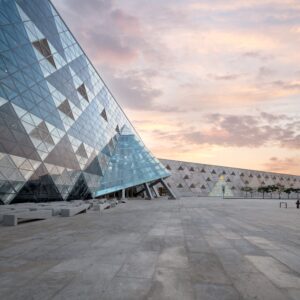
© Grand Egyptian Museum
Design firm Heneghan Peng Architects is now celebrating the official completion of its design of the GEM, which opened to visitors in early November 2025. The $1 billion, 120-acre complex is located about one mile away from the Pyramids of Giza, and is a testament to the longevity and scale of ancient Egyptian civilization and its enduring influences.
Designed to house a total of 100,000 artifacts, the GEM is the largest museum in the world dedicated to a single civilization. The full completion was marked by the opening of the Tutankhamen gallery, which displays more than 5,000 artifacts to the public for the first time.
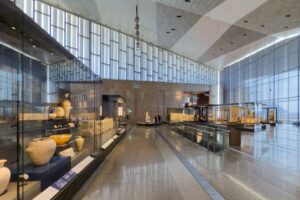
© Ivan Baan
The museum was designed in direct relation to the positioning of the pyramids, bridging the gap between history and modernity. The architects were awarded the project in 2003 after the Egyptian Ministry of Culture launched one of the largest architectural competitions in the world.
“Designing a museum of this caliber and size, in such close proximity to a landmark as monumental as the pyramids, is a once-in-a-lifetime opportunity,” said Róisín Heneghan, founding partner, Heneghan Peng Architects. “Our design works to strengthen that connection to history and place, providing a home for some never-before-seen artifacts that rests upon the very land from which they were created.”
Located on a desert plateau formed by the Nile River thousands of years ago, the museum’s geological setting was integral to the design. Beginning at a focal point outside of the entrance, the museum’s structure radiates outward toward the pyramids along a visual axis that aligns directly with the positioning of the three pyramids. The interior walls follow these lines to create a fanning shape, with the roof sloping upward along a similar visual line to meet the highest point of the pyramids but never surpassing them. This direct dialogue between the museum and the pyramids that makes the pyramids feel like a part of the museum itself.

© Grand Egyptian Museum
The Permanent Exhibition gallery points directly toward the tallest pyramid, and a grand six-story staircase serves as a chronological route to guide visitors through the different galleries, beginning with the Predynastic Period and traveling through the Coptic Era.
Developed with master planning and museological advisory services from Cultural Innovations and Metaphor, the permanent exhibitions, including the new Tutankhamen Gallery, are placed at the top of the staircase, encouraging visitors to immerse themselves in each period before completing the experience with the iconic view of the pyramids.
Many of the largest and heaviest artifacts, including the 10 statues of King Senusret I, are also placed upon the staircase at varying levels.
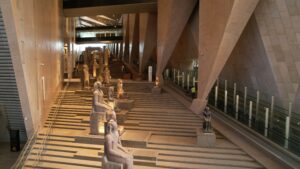
© Grand Egyptian Museum
While natural lighting is typically minimized in museums for conservation reasons, many of the artifacts are stone, creating a unique opportunity to introduce natural lighting wherever possible, particularly in the museum’s main spaces.
The site also includes extensive gardens that provide public green space for the local community. Developed in collaboration with the firm West 8, the Thematic Gardens, Welcome Plaza and Grand Hall represent the juxtaposition of the surrounding landscape, resorting back to the beginnings of Egyptian civilization in the lush Nile valley. The broad, greened forecourt, dotted with date palms, was designed to tell the story of the Nile floodplain that once allowed the stones for the pyramids to be transported by ship. This open area reveals the museum in its full 2,624-foot length, and houses 12 acres of outdoor exhibition space.
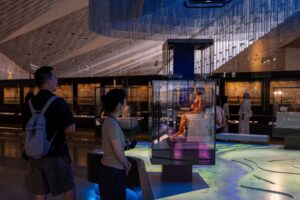
© Georges and Samuel Mohsen / The GS Studio
In addition to the public-facing galleries, the museum was able to conserve and prepare so many artifacts for display. The conservation center, laboratories and storage facilities are connected to the main building via a tunnel, with 17 different labs dedicated to preserving the museum’s priceless artifacts. Given the diversity of materials that make up the collection, the museum’s design caters to artifacts ranging from papyrus and textiles to pottery, sculptures to human remains, which all require unique measures.
Read This Next

Introducing
FX Excursions
FX Excursions offers the chance for once-in-a-lifetime experiences in destinations around the world.
#globility
Insta FeedOctober 2026
Oct 14, 2026Stay Informed on Recent and Upcoming Shifts in Airline Alliance Memberships
Airline alliances allow carriers to share resources and expand routes while offering passengers a wider choice of destinations and flights, as well as the opportunity to earn and spend frequent-flyer miles on a greater number of airlines.
Sponsored Content
Why Japan Is Best Explored by Sea with Princess
Japan is a destination that rewards repeat visits because no two regions — or seasons — feel quite the same. One moment, you’re wandering through centuries-old geisha districts in Kanazawa. The next, you’re watching neon reflections dance across Tokyo streets long after midnight.
October 2026
Oct 14, 2026Time Travel: The World’s Best Aviation Museums Let Visitors Fly Into the Past
The desire to fly is lodged deep in the human psyche. Aside from the common dream of being airborne, references abound in old tales and myths. In the epic poem Shahnameh by long-ago Persian poet Ferdowsi, the fabled King Kai-Káús possessed a flying throne that was drawn into the sky and held aloft by a team of colossal eagles. Built of gold and wood, this throne craft may not have been aerodynamic in design or particularly comfortable to travel in, but it managed to bear the daring king all the way to China.
Destinations / North America
Oct 14, 2026Review: Villatel Resort Orlando
Opened March 2025, Villatel Resort Orlando is one of Orlando’s newest elevated resorts, but far more unique and private than you’ll find at many other resorts and hotels in the area. The name alone points to an experience beyond your typical hotel room or suite; here, you have the flexibility to select from a wide range of modern villas, ranging from four to nine bedrooms, as well as a series of Apartments by Marriott Bonvoy units.
Sponsored Content
Extraordinary Moments, Made to Keep
The Excellence Collection offers a curated collection of luxurious resorts across Mexico and the Caribbean, promising exceptional experiences for every guest and taste. From upscale suite concepts to a plethora of gourmet dining options, from wellness experiences to curated activities, The Excellence Collection guarantees all this and more.
eFlyer News
Oct 14, 2026Amex Announces Largest Centurion Lounge Network Expansion to Date
American Express undergoes its largest Centurion Lounge Network expansion to date across four locations. The network expansion includes a brand-new Centurion Lounge at Newark Liberty International Airport, a second lounge at London Heathrow Airport, and significant expansions of existing lounges at both Philadelphia International Airport and George Bush Intercontinental Airport.

eFlyer Lead
Oct 14, 2026Bed Bugs on Planes? Rare, But It Just Happened …
It’s a traveler’s worst nightmare: bed bugs. The insect’s name suggests they are limited to beds, meaning the worry is restricted solely to homes, hotels, vacation rentals and any other place we could possibly rest our heads. But, on planes? Well, bed bugs have and do indeed infiltrate the fabrics of even these seats, despite many of us not actually getting any rest on a plane.
Sponsored Content
Global Traveler Hosted Trip on the Transcend Connect
JOIN GLOBAL TRAVELER ON ITS NEXT TRIP!
October 2026
Oct 12, 2026The Quest for Quiet: Choose the Best Noise-Canceling Headsets to Suit Your Travel Style
Back in the 1990s, when I was traveling on my airline pilot father’s standby passes, there weren’t many ways for passengers to cancel ambient noise while in flight. I remember squishing and twisting little yellow pairs of foam earplugs with my fingers and letting them rise in my ears while I swirled ice around in my Pawberry Punch and ripped open a cold pouch of Delta-branded Biscoff cookies. Much has changed in travel technology since those days; and although I’ll forever miss Dusty the Delta Air Lion, I’m happy to report no more need for plastic ear foam.
ShareThis